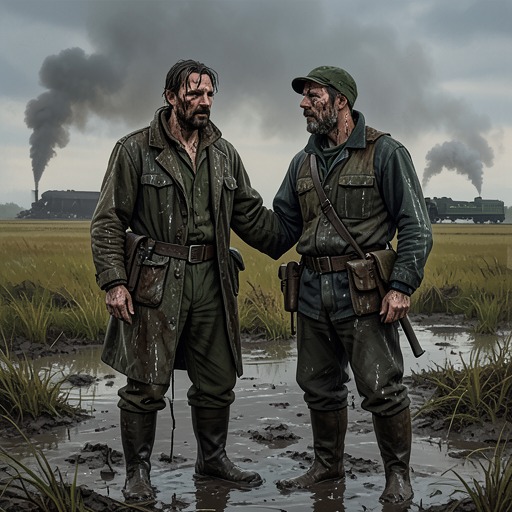
Isaac English and Billy Poe’s bond of loyalty after the factory death
American RustIsaac English and Billy Poe’s bond of loyalty after the factory death is defined by a painful contradiction: the two are implicated in the same crisis, but trust between them is no longer secure. Billy identifies Isaac as involved, and the disclosure forces the people around them to confront the possibility of divided loyalties. Yet Isaac continues to regard Billy as his closest measure of decency, even while fearing what Billy might tell others. Their friendship therefore becomes a test not simply of whether either will speak, but of what loyalty can mean when personal hurt and legal danger pull in different directions.
The Bond Under Pressure
The immediate stakes are shared. Isaac tells Lee English that he and Billy are in trouble, that he has already been questioned, and that he expects to be arrested the following day. The wording places their predicament side by side, but does not make their positions identical: Isaac anticipates arrest for himself, while the prospect of what Billy will say remains uncertain. The bond is already caught between mutual implication and the separate choices each may make.
The factory aftermath also makes practical decisions part of the relationship. In the rush to get help for an injured man, someone insists that they must reach a phone and call emergency services, identifying a Sheetz station as a place to do so. Another remark anticipates that calling an ambulance will bring the police behind it. These details frame the choice to seek aid as inseparable from the risk of official scrutiny. The evidence does not establish that the two friends make every decision together, but it shows how the danger surrounding the factory turns ordinary acts into consequential tests of what they will do next.
Trust and Personal Betrayal
Billy’s account to Lee reveals that the rupture is not only about the factory. He explains the conflict as a discovery that the person he most needed to trust had been involved with his sister while concealing it from him. Lee understands that the revelation changes the terms of the crisis: lawyers will be needed, and Isaac and Billy may not stand on the same side. She frames the situation as a choice between them, while recognizing that her father is implicated in the opposing side of that division. The disclosure makes the friendship’s fracture intimate as well as legal, without erasing the fact that the two remain bound together by the events at the plant.
Lee also recalls that Billy had described nearly freezing in his own yard because he could not face his mother after what had happened. His distress is presented through the consequence of avoidance: he remains outside rather than confronting a family member. As Lee listens, she is no longer able to attend to the story in the same way; her thoughts turn to lawyers, divided allegiances, and the practical work of caring for others. The scene shows how the secret between the friends reaches beyond them, making Lee consider where responsibility lies and what support each person may need.
Loyalty, Disclosure, and Legal Risk
Bud Harris tries to persuade Billy to explain what happened and identify anyone else who was in the plant, arguing that the account could help present the killing as self-defense at trial. His appeal treats disclosure as a means of protecting Billy from a damaging version of events. The request also places pressure on the loyalty between Billy and Isaac: naming another person could alter the case, while silence leaves Billy facing the consequences of a story in which he killed a man and left the scene. The evidence establishes Harris’s argument and Billy’s position as its intended listener; it does not establish what Billy ultimately tells investigators.
Isaac, for his part, anticipates that the truth will eventually emerge. He thinks the others will discover what he did and expects that Billy will talk. But the expectation does not reduce Billy, in Isaac’s mind, to a threat or an enemy. Even as he worries about disclosure, he concludes that Billy is the best of them. That judgment holds together fear and admiration rather than resolving them. Isaac’s confidence in Billy’s character persists even when he cannot count on Billy’s silence.
The jacket adds a material trace of the danger to this question of trust. Bud Harris has hidden a jacket belonging to Billy, and later worries about its connection to him while sitting with Steve Ho. Harris distinguishes the act of hiding it from the reason it troubles him: the jacket is Billy’s. The concealed garment links Billy to the predicament without, on the evidence available here, proving what Billy did. Its presence makes the unspoken arrangement tangible: protection may involve withholding evidence, while the personal object keeps the person being protected at the center of the risk.
A Friendship Without an Easy Resolution
The authorities’ questions widen the consequences. Someone asks whether Isaac had anything to do with what happened, reporting that Isaac’s father said he had left two days earlier and had not been seen since. In a separate appeal, an interlocutor urges Billy to talk for the sake of his mother, presenting cooperation as the only chance available. The two moments place absence and speech in tension: Isaac has left, while Billy is being pressed to account for events. Neither establishes the final outcome of the other’s choices, but both make clear that their friendship is entangled with family obligations and an approaching legal process.
The relationship’s defining image is consequently not uncomplicated solidarity but loyalty under strain. Billy’s identification of Isaac and his account of the concealed relationship expose a breach; Harris’s request for an account makes silence costly; Isaac’s expectation that Billy may speak acknowledges that breach of secrecy as a real possibility. Still, Isaac’s final private assessment preserves a measure of faith in his friend. The bond survives in that divided form—damaged by betrayal and threatened by testimony, yet not reduced to self-protection alone. The evidence leaves the friends’ eventual legal positions unresolved, and that uncertainty is central to the relationship: neither trust nor its loss has yet become final.